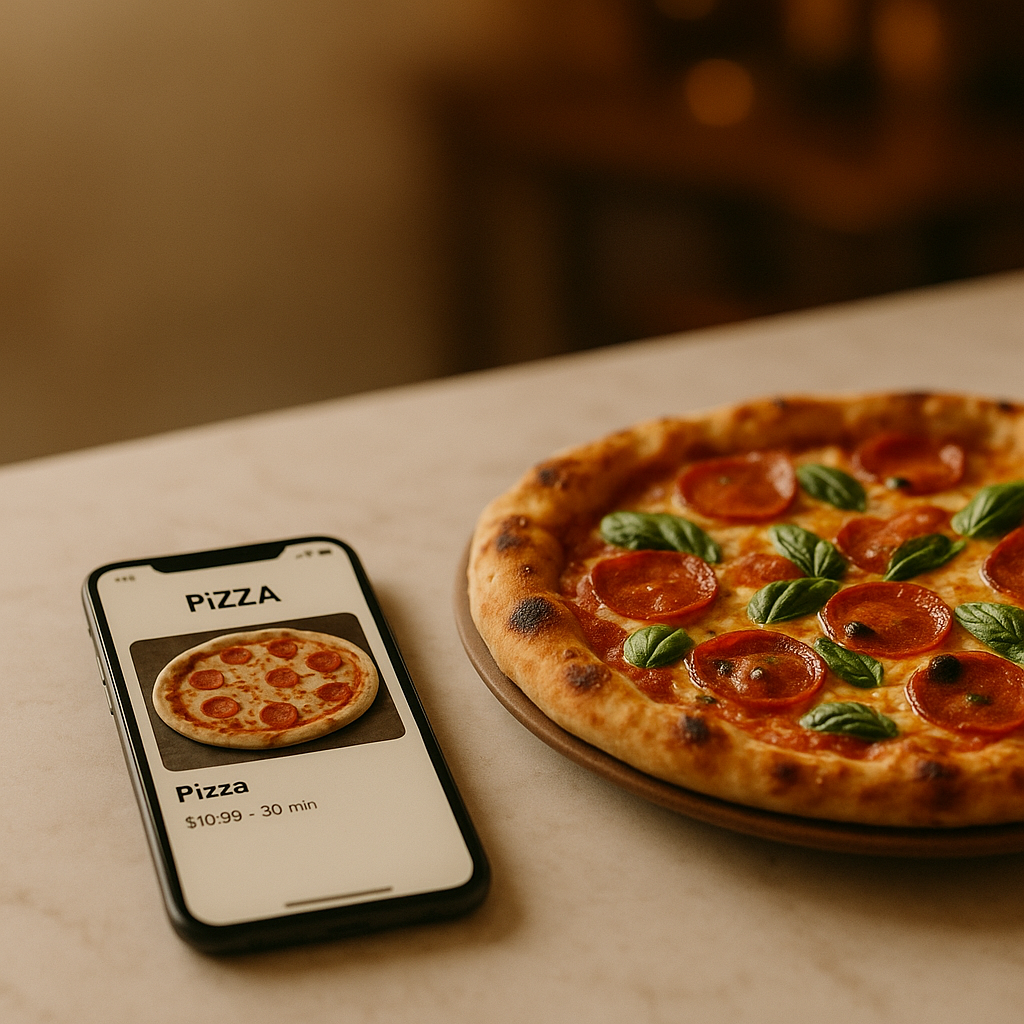
Your pizza might taste legendary, but on delivery apps it sells only if the image stops the scroll. If you’ve been searching for “pizza photos Uber Eats” advice—or wondering why clicks don’t become orders—this guide breaks down what’s going wrong and shows how to fix it fast.
The real reasons your pizza photos don’t sell
Most underperforming pizza shots share a few silent killers:
- Wrong crop for the feed: edges cut off, no clear focal point, and toppings lost in auto-cropping.
- Flat, orange lighting: mixed bulbs and overhead fixtures turn cheese waxy and sauce muddy.
- Grease glare: uncontrolled shine makes the slice look cold and slick.
- Toppings chaos: uneven distribution reads as skimpy or messy, hurting perceived value.
- No “moment”: a lifeless whole pie lacks pull; a slice stretch signals craveability.
- Weak color contrast: beige-on-beige (crust + cheese) without basil or sauce peeks fades in the grid.
- Messy presentation: burnt blisters, flour dust, sauce smears, and oily box liners signal carelessness.
- Inconsistent style: three different backgrounds and angles on one menu confuse the eye and reduce trust.
- Scale confusion: tiny plates or oversized props distort portion expectations.
- Text overlays: banners, stickers, and watermarks reduce clarity and may get downranked or cropped off.
Pizza photos Uber Eats: how the platform displays and ranks images
On a crowded feed, Uber Eats relies on small tiles to win the first click. That means:
- Thumbnails are your storefront. The primary image must read instantly at small sizes. Think: bold focal point, high contrast, and a clean edge-to-edge composition.
- Auto-cropping happens. If your hero detail lives on the edge, it’s likely to be trimmed in the feed, category pages, or promotional carousels. Keep the subject in a safe central area.
- Consistency helps. A unified visual system (lighting, angle, background) makes your brand look established, which can support clicks and order confidence.
- Performance signals matter. While platforms don’t reveal exact formulas, industry reports indicate that click-through rate and conversion-to-order influence visibility over time. Better photos earn more taps; better taps become more orders; that loop tends to lift ranking.
- Recency and testing. New or refreshed visuals often get short-term exposure; use that window to test images for your best-sellers.
The takeaway: your image must both attract the first tap and set clear expectations that reduce drop-off on the dish page.
Fixes you can implement this week
Start with a focused shot list and a simple, repeatable setup.
1) Decide your hero angle
- Top-down (90°): Best for fully loaded pies where symmetry and topping density matter.
- Three-quarter (25–45°): Great for crust height, cheese melt, and slice pulls.
- Tight close-up: Use sparingly to highlight texture—charred leoparding, glossy sauce, fresh herbs.
2) Light like it’s daylight
- Use a single window or soft light. Turn off warm overheads to avoid color casts.
- Diffuse harsh sun with a thin white curtain or parchment.
- White balance to neutral so cheese is creamy (not orange) and basil is green (not brown-green).
3) Style for craveability
- Distribute toppings intentionally so every slice shows value.
- Brush edges with a tiny bit of oil for sheen; dab excess grease on cheese with a napkin.
- Create a “moment”: lift one slice for a clean cheese stretch; wipe drips; capture it fast while hot.
- Add fresh basil, oregano, or arugula last to pop color. Let a little sauce peek through for contrast.
4) Compose for the feed
- Fill the frame. Leave a small safe margin so auto-crops don’t amputate the hero area.
- Keep props minimal: a ramekin of chili flakes or a pizza cutter for scale—nothing that steals focus.
- Clean the scene: new parchment in a box, no flour dust, no burnt shards.
5) Show portion and packaging
- Include one delivery-box hero for your top pizza. Open lid, clean liner, and a tidy slice pull reassure delivery buyers.
- Consider a hand entering frame to imply scale—brief, well-groomed, and not blocking the food.
6) Export and upload with intent
- Use high-resolution, square-first crops so the tile stays crisp (e.g., 2000 px+ on the short edge). Always check the latest Uber Eats guidelines for exact specs.
- Keep a consistent look across your top six dishes; aim for the same angle and backdrop.
7) Test, learn, iterate
- A/B test two hero images for your best-seller for one to two weeks each. Track clicks and orders by image.
- Refresh seasonally (e.g., new basil, chili honey drizzle) to earn recency boosts without changing the core dish.
Prefer a shortcut? FoodFix standardizes lighting, angles, and platform-ready crops so your menu looks consistent without a studio day.
Mini case study: from bland tile to scroll-stopper (example)
“Via Stella Pizza” is a mid-town shop with six pies on Uber Eats. Their original photos were dim, shot under kitchen hoods, and every tile used a different background. The Margarita’s cheese looked dull, the Diavola’s pepperoni clumped on one side, and the box shot had oily liner stains.
What we changed in a single session:
- Switched to a three-quarter hero for the Margarita and captured a quick slice pull over a clean box.
- Redistributed toppings evenly and added fresh basil right before the shot for color contrast.
- Moved near a window with a diffuser; turned off warm ceiling bulbs.
- Cropped square, kept the focal action in the center safe zone, and exported high-res.
- Unified the background across all pies for a brand-consistent grid.
Within a few weeks, their feed looked cohesive and the hero pies read instantly at thumbnail size. Industry reports indicate image-led menu refreshes can lift click-through and conversion by roughly 10–30% on delivery apps; results vary by market and execution, but the principle holds: clearer, hotter, and more consistent images earn more taps and trust.
They chose FoodFix to keep the look consistent going forward, producing fresh seasonal variants quickly without tying up staff or hiring a crew each time.
Fast-track with FoodFix
If speed and consistency matter, FoodFix is built to make menu images perform on delivery apps:
- 99-second turnaround for new or refreshed shots—ideal when you need promos live now.
- Simple pricing that scales: €1.5 per shot, a €45/month Pro plan with 30 photos, or a €225 full‑menu package.
- Platform-ready outputs tailored for Uber Eats, Glovo, and Just Eat so crops don’t ruin your hero detail.
- Consistent style across your whole menu, minimizing visual friction and helping your brand look established.
Use it to update a single hero tile before the dinner rush, roll out a new specialty pie, or re-style your top six dishes into a cohesive grid—without scheduling a studio day.
FAQ
What photo size or aspect ratio works best for Uber Eats pizzas?
As of writing, square images are commonly used for menu tiles, with larger horizontal crops for banners. Aim for high-resolution exports (e.g., 2000 px+ on the short edge). Always check current Uber Eats guidelines before uploading.
Should I show a whole pie or a slice?
Both have a role. Use a whole pie for clarity and value, then create a variant with a clean slice pull to add craveability. Keep the pull in the center safe zone so auto-cropping doesn’t cut the action.
How do I prevent greasy shine and dull cheese?
Control light and oil. Diffuse your key light, lightly brush the crust for controlled sheen, dab excess grease on cheese, and white-balance so yellows don’t go orange. Shoot while hot for natural gloss, then edit for contrast—not saturation.
How often should I change my lead photo?
Rotate seasonally or when performance stalls. Test one new hero at a time for one to two weeks to collect click and order data. Avoid changing multiple variables at once so you know what worked.
Can smartphone photos compete with pro shots?
Yes—if you master light, styling, and crop. A single soft light source, clean composition, and a compelling “moment” will beat a poorly lit studio shot. Tools like FoodFix can also standardize outputs when you’re short on time.
Make your pizza look as irresistible as it tastes, and the algorithm—and customers—will follow.